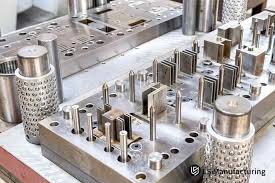

Stamping die tooling represents one of the largest capital investments in a metal parts manufacturing program — tooling costs range from $15,000 to $500,000+ depending on complexity. Understanding stamping die tooling lifespan is essential for accurate program costing, maintenance planning, and production scheduling. A die that fails unpredictably doesn’t just cost money in repairs — it shuts down production lines and creates supply disruptions that can reach $50,000–$200,000 per hour in automotive or electronics manufacturing environments.
What Actually Limits Die Life?
Die life is not a fixed number. It is a variable outcome determined by the interaction of four factors:
• Workpiece material: Its hardness, abrasivity, and thickness determine the rate of cutting edge wear
• Die steel selection and heat treatment: The hardness, toughness, and wear resistance of active die components
• Lubrication: Reducing friction at punch-material and die-material interfaces directly extends tool life
• Maintenance discipline: Scheduled regrinding and preventive maintenance catch wear before it cascades into failure
Understanding how these factors interact allows manufacturers to predict and extend die life rather than react to failures.
Expected Lifespan by Component and Material
| Die Component | Mild Steel | Stainless Steel | Aluminum | HSLA / DP980 |
| D2 Punches (standard) | 500K–1.5M | 200K–600K | 800K–2M | 150K–400K |
| D2 Punches (cryogenic treated) | 750K–2M | 300K–900K | 1.2M–3M | 220K–600K |
| Carbide Punches | 3M–10M+ | 1.5M–5M | 5M–15M+ | 1M–3M |
| Die Blocks (D2) | 1M–3M | 400K–1.2M | 1.5M–4M | 300K–800K |
| Guide Pins / Bushings | 1M–3M | 1M–3M | 1M–3M | 500K–1.5M |
| Spring Packs | 500K–1M | 500K–1M | 500K–1M | 500K–1M |
Carbide tooling commands a 5–15× higher material cost but delivers 6–10× longer life — making it economically superior for any die running more than 500,000 parts/year on abrasive materials.
The Tooling Wear Curve
Die wear does not happen linearly. It follows a three-phase pattern:
Phase 1 — Break-in (0–50,000 strokes):
Micro-surface irregularities from grinding wear smooth. Burr height may initially be higher, then stabilizes. This phase consumes about 5–8% of total die life.
Phase 2 — Stable production (50,000 – 80% of life):
Wear is gradual and predictable. Burr height increases slowly. Maintenance at scheduled intervals keeps quality within specification. This is the economically productive phase of die life.
Phase 3 — Accelerated wear (final 10–15% of life):
Once the work-hardened surface layer of the punch cutting edge wears through, wear rate accelerates dramatically. Burr height increases rapidly. Unplanned failure risk rises sharply. Continuing past this point risks catastrophic punch fracture and die damage extending well beyond normal regrind scope.
The economic implication: die maintenance at 85–90% of life is far cheaper than running to failure, which can require complete punch replacement, die block repair, and production downtime adding up to 3–5× the cost of scheduled regrind.
Tooling Wear and Tear: Measurable Indicators
Maintenance should be triggered by measurable wear indicators, not by calendar time or intuition:
• Burr height: Primary wear indicator. Acceptable maximum is typically 10% of material thickness (e.g., 0.003″ burr on 0.030″ stock)
• Rollover/breakout ratio: On cut edge cross-sections, rollover exceeding 30% of thickness indicates clearance has increased beyond specification due to punch wear
• Punch length: Each regrind removes 0.005″–0.015″ from the punch face. Most punches accommodate 10–20 regrinds before replacement
• Slug pulling frequency: Increasing slug pull rate signals worn or chipped punch cutting edges
• Dimensional drift on pierced holes: Holes growing larger over time indicate die button wear; holes shrinking indicate punch wear.
Die Maintenance Intervals: Planning for Profitability
| Maintenance Level | Trigger | Scope | Typical Cost | Downtime |
| Routine cleaning | Every 50K–100K strokes | Clean, inspect, re-lubricate | $200–$500 | 1–2 hours |
| Light regrind | Burr ≥ 10% of thickness | Regrind active punch faces | $800–$2,500 | 4–8 hours |
| Full regrind + inspection | Every 500K–1M strokes | Regrind all stations, full measurement | $2,500–$8,000 | 1–3 days |
| Major rebuild | Significant wear / damage | Replace worn components, resize | $8,000–$50,000 | 1–3 weeks |
| End of life replacement | Punch at minimum length | New punch/button sets | 30–60% of original tooling cost | 2–4 weeks |
Extending Die Life: Proven Strategies
Manufacturers running precision stamping programs use several strategies to extend tooling life beyond baseline expectations:
• Coatings: TiN (Titanium Nitride) coating adds 2–3 HRC surface hardness and reduces friction by 30–40%, extending punch life by 50–150% at a coating cost of $200–$800 per punch set
• Cryogenic treatment: −300°F deep freeze after heat treatment extends D2 tool life by 15–30% through retained austenite conversion
• Lubrication optimization: Increasing lube viscosity or application rate on abrasive materials can extend punch life by 20–40% with minimal cost impact
• Material certification: Ensuring consistent coil hardness prevents the unexpected wear spikes that occur when harder-than-spec material runs through dies calibrated for softer stock
• Digital maintenance tracking: Tracking stroke count per punch station and correlating with burr measurements creates predictive models that can anticipate regrind needs within ±5,000 strokes
SS Precision implements digital tooling life tracking across all production dies, providing customers with documented die maintenance history, remaining life estimates, and planned regrind schedules — making tooling lifespan predictable and production uptime maximized.
SSPrecision Is a Trusted Partner for Die Manufacturing Cost Optimization
SSP Precision is an ISO 9001 & IATF 16949 certified manufacturer delivering end-to-end precision solutions, from design and prototyping to high‑volume production, for the automotive, medical, electronics, aerospace, and industrial sectors. We handle every stage in‑house – DFM engineering, rapid prototyping, CNC machining, EDM, grinding, and global logistics – to manufacture the tooling that makes your parts and the parts themselves.
What we build and supply: visit our sites: https://ssprecision.com.cn/
- Stamping dies manufacturing and stamping die parts – high‑precision transfer stamping dies and progressive/compound dies for volume metal stamping.
- Injection molding and injection mold – custom injection molds for plastic components, including single‑, multi‑cavity, and over‑molding & insert‑molding tools that combine metal and plastic in one part.
- Specialty molded components – eco‑friendly green mold parts and microscopic medical micro‑molded parts.
- Precision metal and plastic end‑use parts – high‑volume serial production of precision products (metal stampings, plastic moldings) with full PPAP traceability.
Tooling spare parts manufacturing & – tooling spare parts (punches, inserts, ejector pins) and precision robotics spare parts to keep your production running.