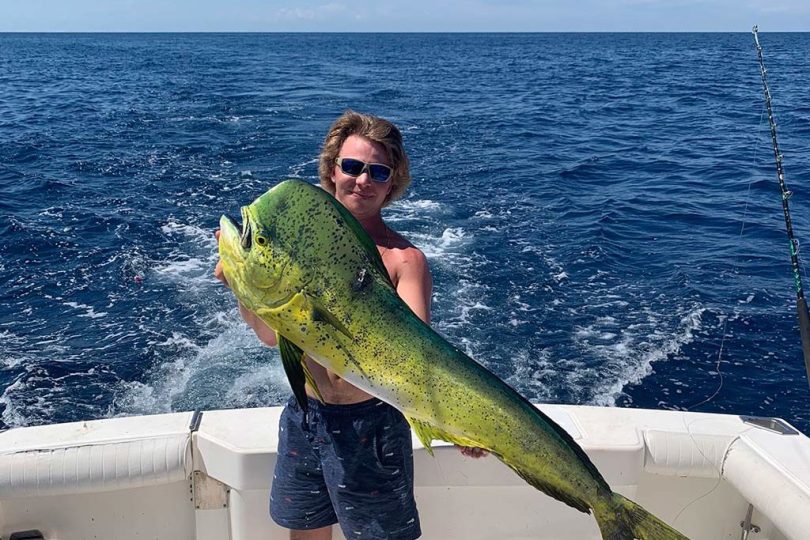

If you’re learning how to troll for mahi mahi, focus on fishing around floating weed lines, current edges, and offshore debris where baitfish gather. Troll a balanced spread of properly rigged lures at a speed that keeps each lure swimming naturally rather than skipping across the surface. Observation and presentation consistently outperform guesswork.
Sunrise Changes Everything
There are mornings offshore when the ocean feels almost empty. The radio is quiet. The rods bounce gently behind the boat, and the only sound is the steady rhythm of the engines cutting through calm water.Then someone spots a patch of floating sargassum drifting with the current.A few flying fish scatter across the surface.
Moments later, flashes of electric blue and brilliant green explode behind the boat as a school of mahi-mahi races toward the trolling spread.The transformation happens so quickly that first-time anglers often think they simply got lucky.Experienced captains know it wasn’t luck at all.
Mahi-mahi are highly visual predators that spend much of their lives searching for structure, bait, and favorable water conditions. Learn where those conditions exist, and you’ll spend far less time searching for fish.
This guide explains how experienced offshore anglers consistently locate mahi-mahi, choose effective trolling presentations, and avoid the common mistakes that keep many beginners from turning opportunities into hookups.
Why Mahi-Mahi Behave Differently
Unlike some offshore predators that roam deep open water, mahi-mahi are naturally curious.
Anything floating offshore has the potential to attract them.
That could be:
- A long weed line
- A floating log
- Ocean debris
- A navigation buoy
- Even a lone piece of driftwood
These objects create small ecosystems.
Tiny marine life gathers first.
Then baitfish arrive.
Soon after, predators like mahi-mahi begin hunting nearby.
Instead of trolling aimlessly across open water, experienced anglers concentrate their efforts around these natural gathering points.
Understanding this simple behavior immediately makes your search more efficient.
Where to Find Mahi-Mahi Offshore
Fish the Weed Lines
If there’s one feature consistently associated with mahi-mahi, it’s floating sargassum weed.
Weed lines provide:
- Shade
- Protection for baitfish
- Food sources
- A natural travel route for predators
Rather than crossing a weed line once and moving on, troll parallel to it whenever possible.
Keeping your lures near the edge allows them to stay in productive water for longer periods and increases the chances of intercepting feeding fish.
Don’t Ignore Floating Debris
Offshore debris often looks insignificant from a distance.
A weathered pallet, a drifting branch, or even a small buoy may not seem worth investigating.
To a mahi-mahi, however, these objects create shelter in an otherwise featureless environment.
Always slow down and make a few controlled passes around isolated floating objects before continuing your search.
Even if the first pass doesn’t produce a strike, the second or third often does.
Watch the Birds Before the Fish Finder
One mistake many beginners make is staring at the electronics while ignoring what’s happening above the water.
Birds frequently reveal feeding activity long before fish appear on the sonar.
Pay attention to:
- Birds repeatedly dive.
- Birds circling one location.
- Small groups moving with the current.
When bird activity overlaps with weed lines or floating debris, it’s usually worth working the area thoroughly.
Build a Simple but Effective Trolling Spread
One of the biggest misconceptions among new offshore anglers is that they need an elaborate spread of expensive lures to catch mahi-mahi.
In reality, a well-balanced spread often outperforms a complicated one.
For beginners, the goal isn’t to cover every possible presentation, it’s to fish a handful of lures that run cleanly and consistently.
A simple spread might include:
- A slightly larger lure positioned closer to the boat.
- Two medium-sized lures running just outside the prop wash.
- A smaller lure placed farther back in calmer water.
This arrangement allows you to cover different water zones while keeping each lure easy to monitor.
Remember, consistency matters more than quantity.
A perfectly tuned four-lure spread will usually outperform six lures that constantly tangle or skip across the surface.
Best Trolling Lures for Mahi-Mahi
Mahi-mahi have a reputation for being aggressive feeders, but that doesn’t mean they’ll strike just any lure you pull behind the boat.
Their feeding behavior changes with the available bait, water clarity, and light conditions. Instead of carrying dozens of lure styles, experienced anglers usually rely on a handful of proven patterns they trust.
Match the Local Bait
Before choosing a lure, spend a few minutes observing what’s happening around the boat.
Ask yourself:
- Are flying fish skipping across the surface?
- Are small baitfish gathering beneath weed lines?
- Is squid present?
- Are birds chasing tiny bait schools?
Your lure doesn’t need to be an exact copy of the bait, but it should create a believable profile.
Natural blue-and-white, green-and-yellow, and pink-and-white patterns remain popular because they imitate many of the baitfish mahi-mahi regularly hunt offshore.
Size Matters More Than Beginners Think
Many new anglers automatically choose the biggest lure they own, hoping to attract the biggest fish.
Mahi-mahi don’t always think that way.
When schools are feeding on small baitfish, oversized lures can appear unnatural. Medium-sized trolling lures often produce more consistent action and are easier for beginner anglers to tune correctly.
Instead of assuming bigger is better, let the conditions and the fish guide your lure selection.
Boat Speed Is Only Part of the Equation
One question appears in almost every offshore fishing discussion:
“What’s the best trolling speed for mahi-mahi?”
The truth is, there isn’t a magic number.
Wind, current, sea state, and lure design all influence how your presentation behaves.
Rather than watching your GPS constantly, watch your lures.
A properly swimming lure should:
- Dive and surface naturally.
- Leave a consistent smoke trail.
- Swim with a steady side-to-side action.
- Avoid spinning or skipping repeatedly.
If one lure isn’t behaving like the others, adjust its position or make a small speed change before assuming the lure itself is the problem.
Don’t Leave After Catching the First Fish
This is one of the biggest mistakes beginners make and one of the easiest to fix.
Mahi-mahi are highly social fish.
When one strikes your lure, there’s a good chance others are nearby.
Many anglers immediately pull in every line and start celebrating.
Experienced crews often do the opposite.
Keep One Fish in the Water
If conditions allow and local regulations are followed, leaving a hooked mahi-mahi in the water for a short time can keep the school interested while another angler presents a lure or pitch bait.
Schools of mahi-mahi are naturally curious and frequently remain close together.
This simple strategy can turn one hookup into several.
(Always handle fish responsibly and follow local fishing regulations regarding retention and handling.)
Captain’s Log: A Lesson I Learned Offshore
A friend once invited me aboard his boat after weeks of telling me he couldn’t understand why mahi-mahi never seemed to stay around.
We reached a beautiful weed line just after sunrise.
Within minutes, one rod bent hard.
The crew cheered, reeled every other lure into the boat, landed the fish quickly, took a few photos, and immediately started running toward another floating object nearly a mile away.
They never realized what had happened.
A second school of mahi-mahi was still swimming beneath the original weed line.
We had left feeding fish behind.
That morning reinforced a lesson many experienced captains already know:
Sometimes the best move isn’t moving at all.
Give productive water enough time before deciding to leave.
Common Mistakes When Trolling for Mahi-Mahi
Fishing Too Fast
Speed should support lure action not replace it.
If your lures are constantly skipping across the surface, they’re unlikely to appear convincing.
Ignoring Floating Structure
Open water can be productive, but weed lines and floating debris consistently attract bait and predators.
Whenever possible, make these areas your priority.
Changing Every Lure at Once
When fishing slows down, avoid replacing your entire spread.
Change one variable at a time such as lure color, position, or size so you can identify what actually improves results.
Leaving Productive Water Too Soon
Patience catches fish.
If you have clean water, visible bait, and active bird life, give the area several passes before moving elsewhere.
Quick Checklist Before You Troll
Before setting your spread, take one final look around.
✔ Weed line nearby
✔ Bird activity present
✔ Lures swimming correctly
✔ Hooks sharp and secure
✔ Leaders free from damage
✔ Floating debris identified
✔ Crew aware of landing plan
Five minutes of preparation often save hours of frustration.
Frequently Asked Questions
What is the best lure color for mahi-mahi?
Natural baitfish colors work well in clear water, while brighter patterns such as green, yellow, or pink can improve visibility in changing light or slightly stained water.
How close should I troll to a weed line?
Whenever it’s safe, troll parallel to the weed line rather than crossing it repeatedly. This keeps your lures in the strike zone longer without disturbing the structure.
Do mahi-mahi travel alone?
Sometimes, but more often they’re found in pairs or schools. Landing one fish may indicate that several more are nearby.
Can beginners catch mahi-mahi?
Absolutely. Mahi-mahi are one of the most beginner-friendly offshore species because they’re aggressive feeders and often respond well to properly presented trolling lures.
Conclusion
Learning how to troll for mahi-mahi is less about covering endless miles of open ocean and more about understanding where life gathers offshore.Weed lines, floating debris, baitfish, and bird activity all tell part of the story. Combine those clues with a balanced trolling spread, dependable lure presentation, and a willingness to slow down in productive water, and you’ll dramatically improve your chances of success.
Perhaps the biggest lesson is this: offshore fishing rewards observation. The anglers who consistently catch mahi-mahi aren’t simply lucky; they notice the small details that others overlook.With every trip, your ability to read the ocean will improve, and so will your confidence when the next brilliant flash of green and gold appears behind the boat.