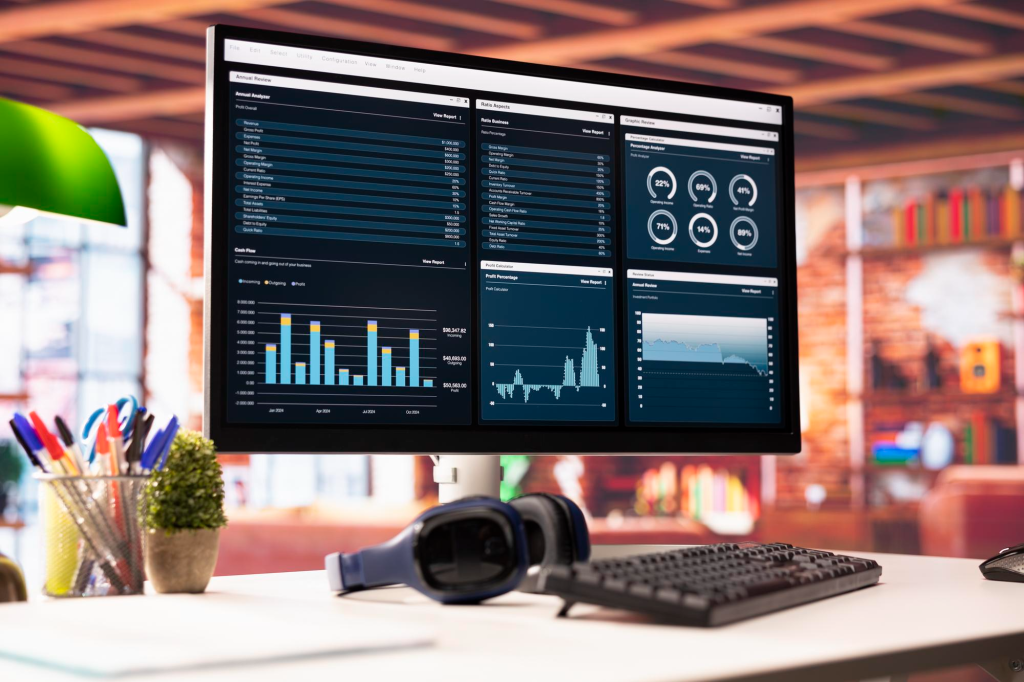
Managing invoices, reconciling transactions, tracking expenses, and staying compliant can quickly overwhelm small business bookkeepers when done manually. Modern accounting software simplifies these everyday challenges through automation, real-time reporting, and smarter financial management tools.
Key takeaways
- Automation Saves Time: Routine bookkeeping tasks are completed faster with minimal manual effort.
- Real-Time Visibility: Financial reports and cash flow data stay updated at all times.
- AI Improves Accuracy: Smart systems reduce errors and detect unusual transactions early.
- Easier Compliance: Organized financial records simplify VAT, tax filing, and reporting processes.
Remember a time when running the books for a small business used to look like handling stacks of receipts, manual data entry, and late nights reconciling spreadsheets? The picture is vastly different today!
Gone are the days of manual bookkeeping! New-age professionals are resorting to the means of digital tools to keep businesses running smoothly. And this holds true for big and small companies alike.
Accounting software is no longer a luxury for small companies. It has become a crucial element in how daily financial operations are handled.
In the UAE, small and medium-sized enterprises (SMEs) represent over 94% of all operating businesses and contribute more than 50% to the nation’s GDP. This massive footprint is driving a massive tech migration; the UAE cloud accounting software market is projected to reach USD 37.93 billion, with small and medium businesses anchoring a commanding 62.34% share of that market spend.
If you own a small business or have a startup and are still in two minds about whether this technology will empower your company, let us read the blog and explore the primary ways this will help you.
Was the Old Way Holding Bookkeepers Back?
Unfortunately, yes. Small business bookkeeping was basically a combination of manual processes and disconnected tools. Imagine how difficult it would be for the bookkeeper to juggle one app for invoices, another for expenses, a spreadsheet for bank reconciliation, and a separate file for tax records!
Needless to say, this fragmented approach naturally created room for error at every step.
Bookkeepers had to spend hours on:
- Manually entering transactions from bank statements
- Cross-checking invoices against payments one by one
- Preparing VAT or tax returns from scattered data sources
- Chasing clients for missing receipts and documentation
- Producing financial reports that were already outdated by the time they were ready
Even with errors happening, it can be understood that these were not failures of skill. Instead, they were failures of processes.
But with the rise of accounting software for small businesses, these problems can now be tackled efficiently.
How Has Modern Accounting Software Eased the Process for Small Business Bookkeepers?
A modern accounting platform takes no haphazard approach; it is seamless and is built around automation, integration, and real-time visibility. It goes beyond storing financial data; it actively processes it.
Automated Bank Reconciliation
Matching bank transactions to recorded entries is quite an extensive process. Modern book keeper software eases this process to a great extent – it connects directly to bank accounts and automatically categorizes and reconciles transactions as they come in.
What used to take hours now takes minutes! Everything gets done in just a click.
Invoice and Billing Automation
The brilliance of accounting software lies in the fact that a bookkeeper can now create, send, and track invoices from a single dashboard. Several platforms help bookkeepers with:
- Automatic payment reminders for overdue invoices
- Real-time status tracking – sent, viewed, paid, or overdue
- Recurring invoice scheduling for regular clients
- Integration with online payment gateways for faster collections
Owing to these features, bookkeepers do not have to stay in the loop of taking a follow-up; they are free to invest time in other important things.
Real-Time Financial Reporting
How tedious is it to prepare a profit and loss statement from scratch at the month’s end! But today’s modern accounting software for small businesses generates live P&L reports, balance sheets, and cash flow statements, helping the bookkeeper to check the current state of the business at any point in time.
They can thus share accurate, up-to-date financial data with business owners or accountants instantly; there is no more the need to wait for a reconciliation cycle to close.
How AI Is Taking It Further?
The integration of AI has enabled the latest generation of accounting software to go beyond automation. Smart systems have made bookkeeping easier than one can imagine.
It is a one-time thing for an AI-powered platform to learn how a business categorizes its expenses and then apply those patterns automatically going forward. This naturally flags unusual transactions, identifies potential compliance issues, and even predicts future cash flow based on previous data.
This trend isn’t just theoretical. The UAE boasts one of the highest AI adoption rates. Locally, integrating AI-driven features like automated document scanning and duplicate-invoice detection has already proven to cut month-end financial closing times by up to 40%.
Small business bookkeepers benefit from AI-powered book keeper software by getting:
- Smart categorization – transactions are classified automatically with high accuracy
- Anomaly detection – unusual entries are flagged before they become problems
- Predictive insights – cash flow forecasts help business owners plan ahead
- Document extraction – receipts and bills are scanned and processed without manual input
As can be seen, AI drastically reduces the cognitive load of the job for bookkeepers.
Will Tax and Compliance be Made Simpler?
Modern accounting software helps bookkeepers manage tax compliance more efficiently by keeping financial records organized, accurate, and filing-ready from the start.
With the active implementation of the standard 9% Corporate Tax rate and the FTA’s tax registry now surpassing 1.2 million registrants, manual tracking is becoming a compliance liability. Furthermore, continuous monitoring frameworks—including the progressive rollout of structured e-invoicing—mean that minor bookkeeping inconsistencies are flagged by authorities almost immediately, making automated data validation an operational safety net.
| Compliance Challenge | How Accounting Software Helps |
| VAT Filings | Automatically organizes transactions for faster and more accurate VAT preparation |
| Corporate Tax Returns | Maintains structured financial records required for tax reporting |
| Regulatory Submissions | Reduces manual work by keeping financial data centralized and accessible |
| Error-Prone Manual Processes | Minimizes mistakes through automation and real-time tracking |
| Time-Consuming Filing Preparation | Speeds up submissions with ready-to-use financial reports |
Table: How Accounting Software Simplifies Tax Compliance for Small Businesses
Hence, owing to the modern accounting software for small businesses, small business bookkeepers can help businesses stay compliant with tax regulations more confidently and efficiently.
More Time for What Actually Matters
A bookkeeper who spends less time on data entry and more time on insight becomes a far more valuable asset to any small business.
Small businesses can now have:
- Cleaner, more accurate financial records
- Faster invoice-to-cash cycles
- Better visibility into business performance
- Reduced risk of compliance errors
- Lower overall cost of financial administration
Choosing the Right Tool for the Job
Not all accounting software is equal. The best platforms for small business bookkeepers are those that combine ease of use with genuine depth – covering invoicing, expenses, banking, payroll, and reporting in one connected system.
If you are a bookkeeper looking to modernise how you work, or a small business owner wanting to give your bookkeeper the best possible tools, exploring dedicated small business accounting platforms is a worthwhile first step. The right software does not replace a good bookkeeper; it makes a good bookkeeper exceptional.