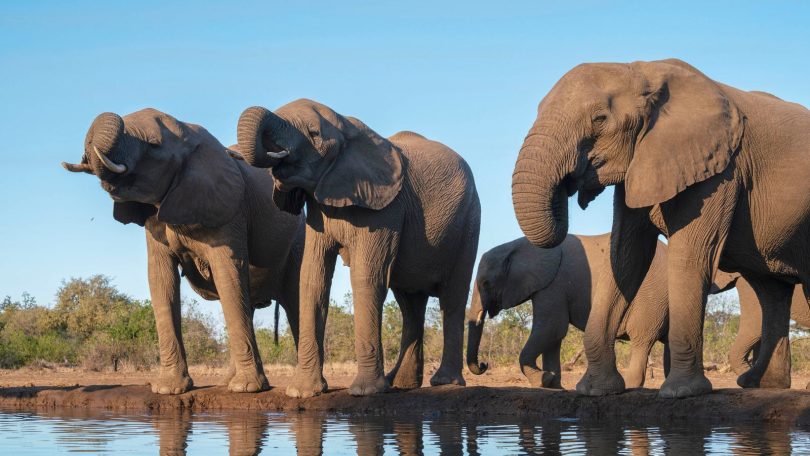

As the dust settles over the Kalahari sands and the sun dips below the horizon, there is a sound that defines the very soul of Botswana: the deep, resonant rumble of an approaching elephant herd. This is the moment that reminds every visitor that while on a safari, we don’t just watch the wild; we live alongside it.
With the largest elephant population in the world, Botswana is famously known as the place “where elephants rule,” but have you ever wondered how these magnificent giants came to dominate this landscape? To understand the massive herds that gather at waterholes today, we have to look back millions of years into the deep history of the African bush.
The Ancestry of Giants: From Moeritherium to the Loxodonta
The story of the elephant can be traced back roughly five million years ago with the emergence of Primelephas. While earlier proboscideans existed, Primelephas holds the direct ancestral link to the modern giants we recognise today. This creature already had the defining characteristics we see in today’s elephants, namely the development of a sophisticated, elongated trunk and the presence of prominent tusks.
As the environment shifted and transformed the landscape, this lineage branched out from those leading to mammoths and Asian elephants, eventually giving rise to the Loxodonta africana. Thus, the African Savannah Elephant emerged from this evolutionary path to find its true sanctuary across Southern Africa, carrying forward the majestic legacy of its Primelephas predecessor.
Botswana: The Last Great Stronghold
Today, Botswana is home to the largest concentrated elephant population on Earth. Recent estimates suggest over 130,000 elephants are roaming these wild spaces, a staggering number that represents nearly a third of the continent’s remaining savannah elephants.
Geographically, this region serves as a vital corridor for the Kalahari giants. These elephants follow ancient migratory paths that stretch across vast, unfenced stretches of wilderness between the Okavango Delta and Chobe National Park.
When the heat of the dry season intensifies and the interior pans evaporate, the elephants rely on their incredible spatial memory to navigate these corridors. Their survival depends on this seasonal movement between the lush wetlands of the Delta and the permanent water sources of the Chobe region, maintaining a natural rhythm that has existed for millennia.
Survival in the Dry Season: Why They Gather Here
In the harsh Botswana wilderness, water is more than a mere resource; it is life itself. An adult bull can drink up to 200 litres of water in a single day. During the dry winter months, when the bush turns golden and brittle, the massive herds will begin their trek toward reliable water sources.
Across Botswana, the commitment to providing safe havens for wildlife has become a cornerstone of conservation. Throughout the country’s vast networks of protected lands, natural and supplemented waterholes serve as critical lifelines for thousands of elephants. It’s a spectacular sight to witness. The elephants will gather in their masses, from tiny, fuzzy-headed calves to weathered matriarchs and towering bulls, all navigating the social hierarchy for a turn at the fresh water.
Watching them, you realize their dominance isn’t just about physical scale; it is rooted in deep intelligence and enduring social bonds. The matriarchs lead their families with a mental map of the landscape passed down through generations, ensuring the survival of the herd in an environment that can be as unforgiving as it is beautiful. This ancient wisdom allows them to thrive within Botswana’s diverse ecosystems, from the arid stretches of the Kalahari to the lush riverfronts of Chobe.
Co-existing with Botswana’s Giants
In Botswana, lodges are designed around the principle of co-existing with the kings of the bush. Living where elephants rule means respecting their space and understanding their rhythm, because their presence shapes the entire experience, from the worn paths through the scrub to the very atmosphere of the camps.
As these giants move through the surrounding wilderness, they act as mega-gardeners, toppling trees to create open grasslands and digging for essential minerals that countless other species rely on.
When you sit on a lodge deck, mere meters from a drinking bull, you become a witness to an evolutionary success story. You are seeing the result of millions of years of adaptation, now thriving in the heart of the African wilderness. It’s truly a special moment to get to watch them closely as they wander through the camp, and observe them as you dine on your private deck.
A Legacy Worth Protecting
The journey from an ancient giant ancestor to the majestic mammals of the Kalahari is one of nature’s most consistent evolutionary stories. Botswana is privileged to hold the keys to the future of this species. By maintaining these vital water points and keeping the land unfenced, conservationists ensure that the rumble of the herds will continue to echo across the savannah for generations to come.
We invite you to sit alongside a waterhole, to pull up a chair, and to marvel at the giants that have made Botswana their home. Here, the history of the elephant isn’t just in the fossil record; it lives right in front of you.